American Night by Wald Alan M.;
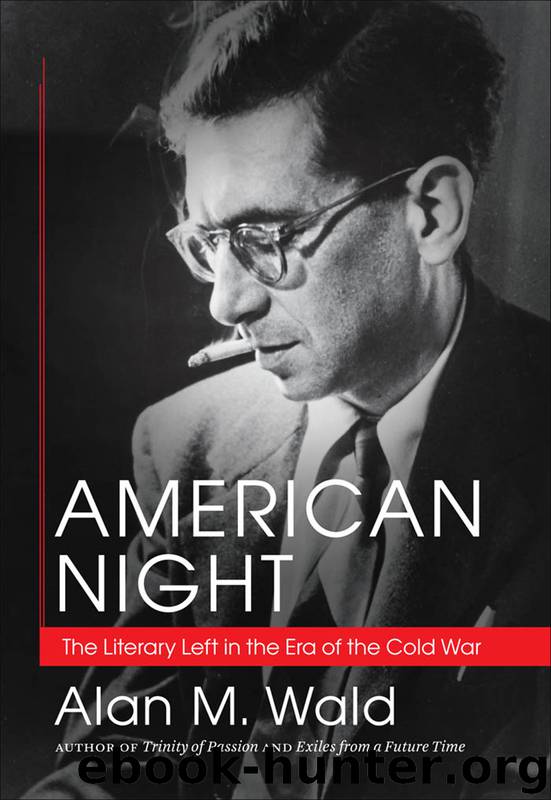
Author:Wald, Alan M.;
Language: eng
Format: epub
Publisher: The University of North Carolina Press
Published: 2010-04-24T16:00:00+00:00
EXILE AND ITS DISCONTENTS
Motley’s writing was never about just homosexuals or African Americans; his gaze focused first of all on the skeins and rags of human existence, shaping them into narratives that layer one story inside another. Like Nelson Algren, Motley felt most comfortable with the very poor, the lumpenproletariat of bums, drug addicts, prostitutes, and hustlers. A growing distance from the 1930s did not mean for Motley a narrowing of social range; on this point, critically unfashionable novelists like Motley and Algren, hewing to the underclass that time forgot, came across as vividly as many who dominate the received memory of the literary 1950s. Motley wanted to use his characters, people on the bottom, to practice new emotional situations; the truth of Black or gay identity would not emerge from this writing like the prize figure in a nest of Russian dolls.
Motley was by no means reluctant to transform African American life into fiction; he just did it badly. In all four of his novels, there are many diverse Black characters; even more appear in writings that he was unable to get into print, including short stories, sections of his novels cut by editors, and plans for future projects. He could come up with striking titles, such as “I Discover I’m a Negro” (an unpublished essay, probably 1943–44) and “The Almost White Boy” (a story published in 1963). But the disclosures of African American life were disappointing when compared to the essays and fiction of the slightly younger up-and-coming James Baldwin. The problem was not that Motley was out to dramatize a clear-cut thesis in the manner of pro-Communist W. E. B. Du Bois (1868–1963), who intended in The Black Flame (1957–61), a massive and ungainly fictional trilogy, to make racism an international issue. Motley aspired only to set Black life in a broad class context, allowing multiethnic bridges to be built and alliances to emerge. African American culture, he seemed to say, was but one of many cultures to which he wanted access. As a foil, he opposed the use of Blackness as a narrow vantage point from which to assess the world. This led him to publish inflammatory articles in 1947 and 1963 claiming that Chester Himes and James Baldwin expressed a hatred of whites and were becoming what he disparaged as “Professional Negroes.”118
One might wonder if there was a self-hatred of Motley’s own African American background behind such unwise pronouncements. Motley’s personal journals are filled with complex and contradictory emotions about his Blackness, complicated by his upbringing in a white middle-class neighborhood and the Roman Catholic faith. A typical passage reads: “This is the first time I’ve really hated being part a Negro. Other times it has been rather fun—like a game—as if I were the prince in a fairy story—under the spell of some evil witch.”119 The sum of these inconsistent feelings, alternately pride and shame about his color, are uncontainable by any label.120 In contrast, in conversation and in many places in his fiction, Motley expressed simplistic views that seem to advocate “racelessness” and “color blindness.
Download
This site does not store any files on its server. We only index and link to content provided by other sites. Please contact the content providers to delete copyright contents if any and email us, we'll remove relevant links or contents immediately.
| African | Asian |
| Australian & Oceanian | Canadian |
| Caribbean & Latin American | European |
| Jewish | Middle Eastern |
| Russian | United States |
4 3 2 1: A Novel by Paul Auster(12609)
The handmaid's tale by Margaret Atwood(7904)
Giovanni's Room by James Baldwin(7540)
Asking the Right Questions: A Guide to Critical Thinking by M. Neil Browne & Stuart M. Keeley(5892)
Big Magic: Creative Living Beyond Fear by Elizabeth Gilbert(5890)
Ego Is the Enemy by Ryan Holiday(5617)
The Body: A Guide for Occupants by Bill Bryson(5282)
On Writing A Memoir of the Craft by Stephen King(5059)
Ken Follett - World without end by Ken Follett(4862)
Adulting by Kelly Williams Brown(4684)
Bluets by Maggie Nelson(4684)
Eat That Frog! by Brian Tracy(4677)
Guilty Pleasures by Laurell K Hamilton(4565)
The Poetry of Pablo Neruda by Pablo Neruda(4233)
Alive: The Story of the Andes Survivors by Piers Paul Read(4143)
The Book of Joy by Dalai Lama(4119)
Fingerprints of the Gods by Graham Hancock(4116)
White Noise - A Novel by Don DeLillo(4092)
The Bookshop by Penelope Fitzgerald(3947)
